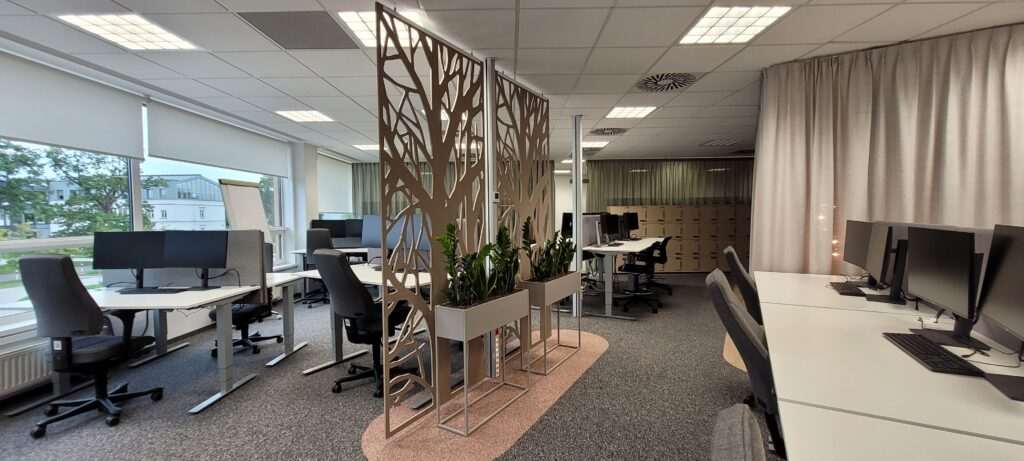
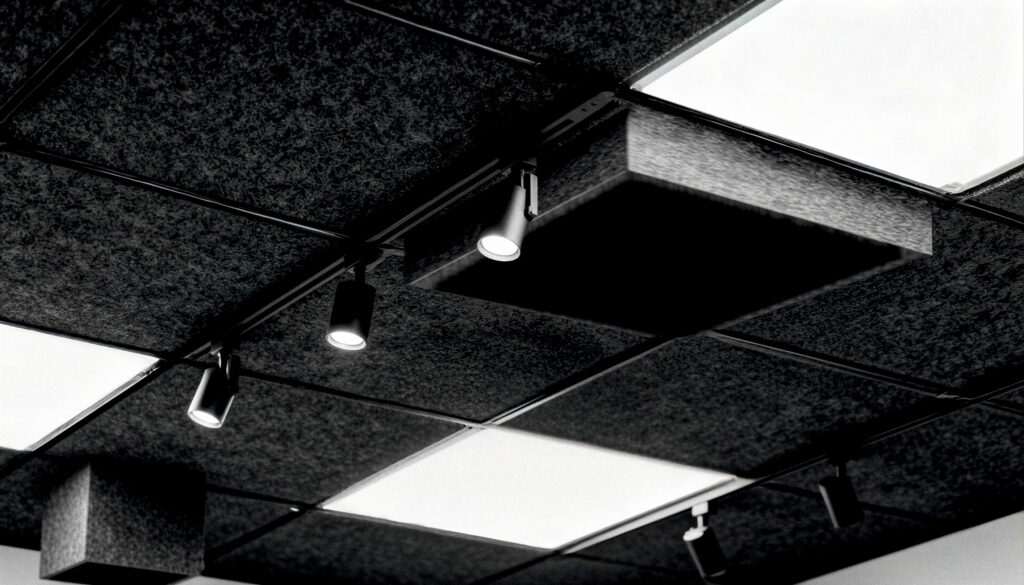
Acoustic panels improve the acoustic comfort of interiors by absorbing sound and reducing reverberation – while also becoming part of the interior design. One of the key technical parameters of panels is their thickness. It affects how effectively a panel “works” with sound and how much it improves the comfort of using the interior. In this article, we explain which acoustic panel thickness to choose to achieve an effect suited to the character of the space and its needs.

Why does the thickness of acoustic panels matter?
The thickness of acoustic panels is one of the key parameters influencing their effectiveness. It is not merely a matter of the amount of material used; rather, it directly affects how the panel interacts with sound waves and determines the efficiency of sound absorption within a given space.
The thickness of acoustic panels affects, among other things:
- range of absorbed frequencies – thicker panels are more effective at reducing a broader band of sounds,
- shortening the reverberation time – which directly translates into greater comfort when working or conversing,
- speech intelligibility – particularly important in offices and meeting rooms,
- perceptible acoustic effect – thin panels adjust the acoustics, while thicker ones provide a tangible improvement,
- the way an interior is perceived – thickness also influences the depth, rhythm, and character of a space.
The form of the panels is also significant. Flat, milled, relief, or three-dimensional panels interact with sound waves in different ways and are suitable for various types of interiors. Therefore, the choice of acoustic panel thickness should always be based on an analysis of the space’s specific needs, rather than on a one-size-fits-all approach.
How does a PET felt acoustic panel work?
PET felt is a porous material that absorbs sound by dissipating acoustic energy within its structure. Sound waves penetrate the material, gradually lose their energy, and do not return to the space as reflections. It is precisely this mechanism that accounts for the reduction of reverberation and the improvement of acoustic comfort.
In the context of PET felt, the thickness of a panel primarily influences the depth at which the material functions. Greater thickness means a larger volume of felt participates in the sound-absorption process, allowing for more effective acoustic control in spaces with higher noise levels. Thinner panels operate at a shallower level, whereas thicker ones facilitate a more complex interaction between sound and the material. It is also significant that PET felt maintains consistent acoustic properties across various thicknesses, which enables the precise selection of panels tailored to the specific function of an interior space.
What are the advantages of PET felt acoustic panels?
PET felt acoustic panels combine acoustic performance with high-quality material and design flexibility. As a result, they are well-suited for use in offices, conference rooms, and other functional spaces.
Eco-friendly solution
The PET felt used in our panels is made from over 60% recycled material. This is a conscious choice that reduces waste and supports sustainable space design—without compromising on quality or durability.
Durability and resistance of the material
PET felt panels are resistant to everyday use, impacts, and scratches. They retain their acoustic and aesthetic properties for a long time, even in spaces subject to heavy use.
Fire resistance
Our acoustic panels, made from PET felt, have a fire reaction classification of B-s1,d0, which confirms their limited combustibility, low smoke emission, and the absence of flaming droplets.
Safety in use
PET felt does not shed dust, is odorless, and is free from volatile organic compounds. Certified material properties allow Felthe acoustic panels to be used in schools, kindergartens, and children’s rooms, without any concerns regarding air quality or user comfort.
Lightweight construction and installation flexibility
The low weight of the panels facilitates their use on walls and ceilings, as well as in the form of freestanding or suspended elements. This allows for the flexible design of a space’s acoustic layout without placing excessive load on the structure.
Design and complete creative freedom
PET felt acoustic panels can serve as an integral element of interior architecture. With 48 available colors, as well as a variety of formats, thicknesses, and shapes, they offer designers complete flexibility in tailoring the panels to the character and function of a given space.

What thicknesses are available for acoustic panels?
Acoustic panels are available in several thicknesses to suit various acoustic and design requirements. Our range includes panels with thicknesses of 9, 12, 18, and 24 mm, allowing for a precise match between the solution and the scale of the space, its function, and the desired acoustic outcome. Selecting the appropriate thickness influences both sound absorption efficiency and how the panels integrate into the interior architecture.
9 mm and 12 mm acoustic panels – when do they work best?
Acoustic panels with a thickness of 9 mm or 12 mm are used in cases where the goal is to improve acoustics rather than achieve full sound control. At this thickness, the panels primarily address the mid-to-high frequency range, reducing echoes and the harshness of sound often found in interiors with many hard surfaces.
In our projects, we use them primarily as:
- acoustic panels on the walls in corridors, small rooms, and auxiliary spaces,
- a solution for balancing acoustics in small spaces,
- an element that complements other sound-absorbing materials.
18 mm and 24 mm acoustic panels – for spaces with higher acoustic requirements
Panels with a thickness of 18 and 24 mm provide a broader absorption range, which translates into better sound control at frequencies critical for speech intelligibility. As a result, they effectively reduce background noise and improve acoustic conditions in larger interior spaces.
In practice, we use them as the foundation of an acoustic system in:
- open-plan offices,
- conference and meeting rooms,
- large-volume common spaces.
In such installations, these panels are used both on walls and as ceiling solutions, where they effectively reduce reflections and stabilize the acoustics of the entire space.
Acoustic panels with an air gap and mineral wool – maximum effectiveness
Maximum acoustic performance is achieved by using panels with an additional air gap and a 50 mm thick layer of mineral wool. This solution enhances the effectiveness of the panels, regardless of their base thickness.
A system like this:
- works broadband,
- significantly reduces reverberation time in large rooms,
- improves acoustic privacy and speech comfort.
We recommend it for spaces with high acoustic requirements, where standard solutions do not provide a sufficient effect.
Acoustic panel thickness and installation location
The placement of acoustic panels directly influences how their thickness functions and the acoustic effect that can be achieved. The same panel may perform differently when mounted on a wall compared to when it is used as a ceiling solution; therefore, the choice of thickness should always be considered in the context of the direction of sound propagation and the scale of the space.
Wall-mounted acoustic panels
For wall-mounted panels, thickness is of particular importance, as vertical surfaces are responsible for the initial sound reflections within a conversation area. Selecting the appropriate thickness allows for effective control of reverberation and improves speech intelligibility, especially in spaces characterized by a high proportion of hard materials.
When applied to walls, the thickness of the panels also influences the visual perception of an interior. Larger formats and greater depth help establish a sense of rhythm and three-dimensionality, transforming the panels into an architectural element rather than a mere technical accessory. While thin solutions may suffice for smaller spaces, thicker panels offer greater creative freedom in larger interiors—both in terms of shaping the acoustics and defining the overall form.
Acoustic ceiling panels and acoustic islands
In ceiling solutions and acoustic islands, the thickness of the panels plays a different role than it does on walls. Sound propagates vertically, and panels installed above a workspace capture reflections before they can return to the occupied space. As a result, even relatively thinner panels can lead to a significant improvement in acoustics.
For ceilings and acoustic islands, not only the thickness but also the effective surface area and the placement of the panels are of key importance. A well-designed layout can effectively reduce reverberation in large areas—such as open-plan offices or communal spaces—without creating an overwhelming visual impact. Thicker solutions are used where acoustic requirements are more demanding, or where the panels also serve as a prominent design feature.

How do you determine the appropriate thickness of acoustic panels for a specific space?
When selecting the thickness of acoustic panels, we always begin by analyzing the function of the space and the nature of the sound, rather than focusing solely on technical parameters. An intimate office, a meeting room, and a large open-plan space each have different requirements. It is crucial to determine whether the primary issue is reverberation, background noise, or speech intelligibility.
Offices and workspaces
In typical office environments, we generally use a combination of panels with varying thicknesses. Thinner options help correct reverberation in smaller rooms, while thicker panels are employed where greater sound control is required—such as in areas designated for conversation or teamwork. In these spaces, the strategic placement of the panels is just as critical as their thickness.
Open space
In open-plan spaces, the thickness of acoustic panels plays a more significant role due to the scale of the interior and the number of sound sources. We typically recommend thicker panels for such environments, complemented by ceiling-mounted solutions or acoustic islands. This combination helps reduce background noise, shorten reverberation time, and improve workplace comfort without requiring an excessive number of elements on the walls.
Meeting and conference rooms
In meeting rooms, speech intelligibility is the priority. We select panel thicknesses with a focus on effectively controlling reverberation within the frequency range critical for conversation. Thicker panels—applied strategically on walls or as ceiling solutions—ensure clear, intelligible sound, even when a large number of participants are present.
Representative spaces
In reception areas and other representative spaces, we select panel thicknesses that balance acoustic functionality with interior aesthetics. We often opt for solutions with greater depth, which both enhance acoustic comfort and serve as a striking design feature. In such projects, the acoustics must function discreetly, without visually dominating the space.
How to choose the right acoustic panels?
When selecting acoustic panels, we consider thickness to be one component of the overall system, rather than the sole parameter determining the effectiveness of the solution. To achieve a tangible acoustic impact and ensure harmony with the interior architecture, it is worth focusing on several key aspects:
- Function of the space – homes and apartments have different acoustic requirements, where panels enhance comfort and aesthetics, whereas office spaces have different needs, as acoustics there directly affect the quality of work and communication.
- Active surface area of the panels – a larger number of well-distributed panels often yields a better result than a few very thick elements applied at specific points.
- Panel placement – panels should be positioned where the first sound reflections occur, rather than simply in the locations that are easiest for installation.
- Installation location – the decision to apply panels to walls, ceilings, or as suspended islands should be based on the direction of sound propagation and the scale of the interior.
- Coherence with the interior architecture – the thickness, form, and color of the panels influence the perception of the space; a well-designed solution does not appear as a technical fix, but rather as an integral part of the interior design.
In more complex spaces, the selection of acoustic panels should be approached as part of a broader acoustic design project, rather than as a decision based solely on catalog specifications.

Most common mistakes when choosing the thickness of acoustic panels
When selecting acoustic panels, it is easy to fall into a few recurring patterns that lead to disappointing results. These often stem from oversimplifications or from treating thickness as the sole indicator of effectiveness.
- Choosing panels “just in case”
Opting for the thickest possible panels does not always improve acoustics. In small or medium-sized spaces, it can lead to an overly “damped” interior or fail to provide a benefit proportional to the costs incurred. - Neglecting the active surface area
Using a few, very thick panels in isolated spots rarely solves an acoustic problem. A much better result is achieved by using an appropriate number of panels, positioned in the locations where the first sound reflections occur. - Lack of alignment with the function of the interior
The same thickness specification will not perform equally well in a home, a meeting room, and an open-plan office. Ignoring the functional context leads to solutions that are either inadequate or unnecessarily elaborate. - Treating acoustic panels as sound insulation
Acoustic panels improve acoustic comfort and reduce reverberation, but they are not designed to insulate rooms against external noise. Expecting them to “soundproof” walls is one of the most common design errors. - Focusing solely on the thickness parameter—while overlooking aspects such as installation location, panel layout, or panel form—leads to solutions that are inconsistent in both acoustic and visual terms.
- Lack of consultation in complex spaces
In large or multifunctional interiors, selecting panel thickness on one’s own is often insufficient. Without an acoustic analysis, it is easy to overlook issues that only become apparent once the space is put into use.
Summary
Selecting the appropriate thickness for acoustic panels should not be based on a single parameter or a one-size-fits-all formula. The context—the function of the space, its scale, and how it is used—is of critical importance. Only by considering these factors together can one choose solutions that effectively improve acoustic comfort while remaining consistent with the interior architecture.
Well-designed acoustic panels function as a system; therefore, in more demanding spaces, it is worth approaching their selection thoughtfully—taking into account both acoustics and aesthetics.
If you are planning a project where acoustics matter, contact us – we will help you choose the thickness and form of panels suited to your specific space.