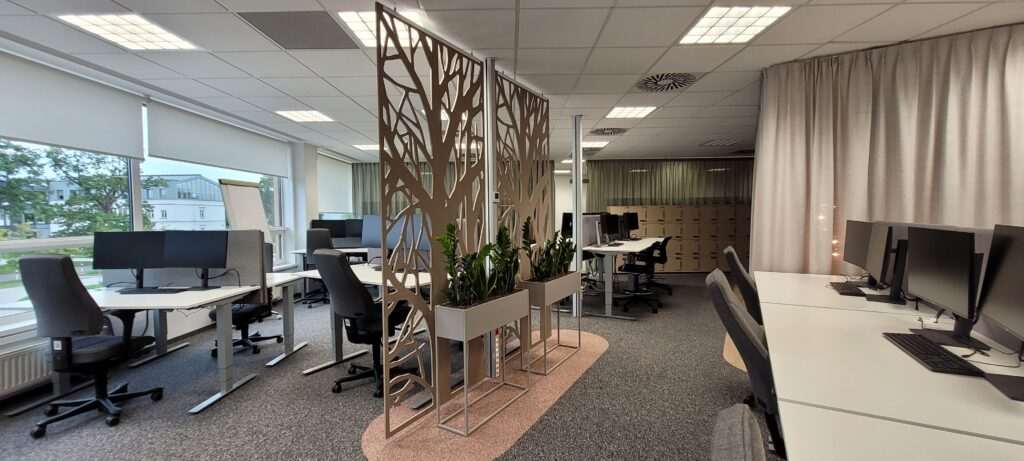
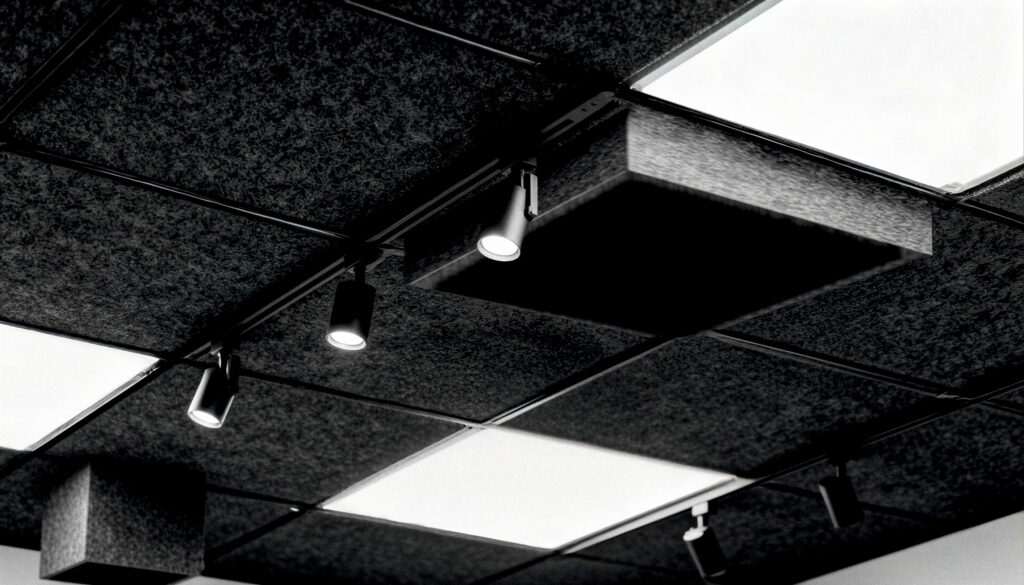
Modern offices are increasingly designed to support concentration, health, and work efficiency. One of the key elements that significantly impacts the daily experience of employees is interior acoustics. This is why designers are turning to acoustic panels made from PET felt—a solution that combines aesthetics with an effective way to enhance comfort.

Why has office acoustics become a priority?
Noise in open-plan offices is one of the most frequently reported problems. Conversations, phone calls, and office equipment—all of these contribute to higher noise levels, which cause fatigue, create distractions, and reduce productivity.
Studies show that high noise levels in offices can reduce efficiency by as much as 60%. Employees lose focus more easily, tire more quickly, and experience higher levels of stress. The work environment is no longer just a matter of visual design—it must support the well-being and productivity of teams.
Why is PET felt ideal for improving the acoustics of office spaces?
PET felt is lightweight, durable, and made from recycled materials—making it perfectly suited to modern design requirements. Its porous structure effectively diffuses and absorbs sound, which helps to significantly reduce reverberation in a room.
Additionally:
- is safe and resistant to damage,
- it is easy to clean,
- it can be milled, printed, or combined into modules,
- It is available in many colors, which offers a wide range of design possibilities.
How do designers use panels in offices?
Most often:
- on the walls — to dampen sound in key office zones,
- behind workstations — enhancing the comfort of concentration,
- in conference rooms — minimizing echo during meetings and online conversations,
- on ceilings — when maximum sound-absorption efficiency is required,
- in the form of decorative modules — which serve a dual function: aesthetic and acoustic.
Designers often arrange panels into rhythmic patterns, coordinate their colors with office furnishings, or use milled details to lend the interior an architectural character.

The impact of acoustics on comfort and work efficiency
Well-designed acoustics have an immediate impact on the quality of work in an office. They reduce employee fatigue, help maintain focus, and support efficiency when tasks require deep concentration. At the same time, they foster a sense of privacy in shared spaces, allowing for more relaxed conversations and effective teamwork. As a result, the entire office becomes more acoustically comfortable—organized, welcoming, and tailored to the actual needs of its users.

Practical tips for designers
Always analyze the room layout and the dominant sound sources.
Choose panels with the appropriate thickness and surface.
Combine formats and colors to build an aesthetic yet functional composition.
Keep in mind that the best effect is achieved by combining panels on both the walls and the ceiling.
Collaboration with Felthe
Felthe supports this approach by offering architects concrete tools: complimentary sample sets, visualization materials, prompt technical advice, and practical training. Furthermore, architects who collaborate with Felthe benefit from preferential pricing.
This approach ensures a smooth collaboration, allowing the project to progress without unnecessary barriers—from the initial concept all the way to final implementation. As a result, architects gain a partner that genuinely simplifies their work, enabling the creation of spaces that are acoustically conscious, aesthetically pleasing, and refined in every detail.